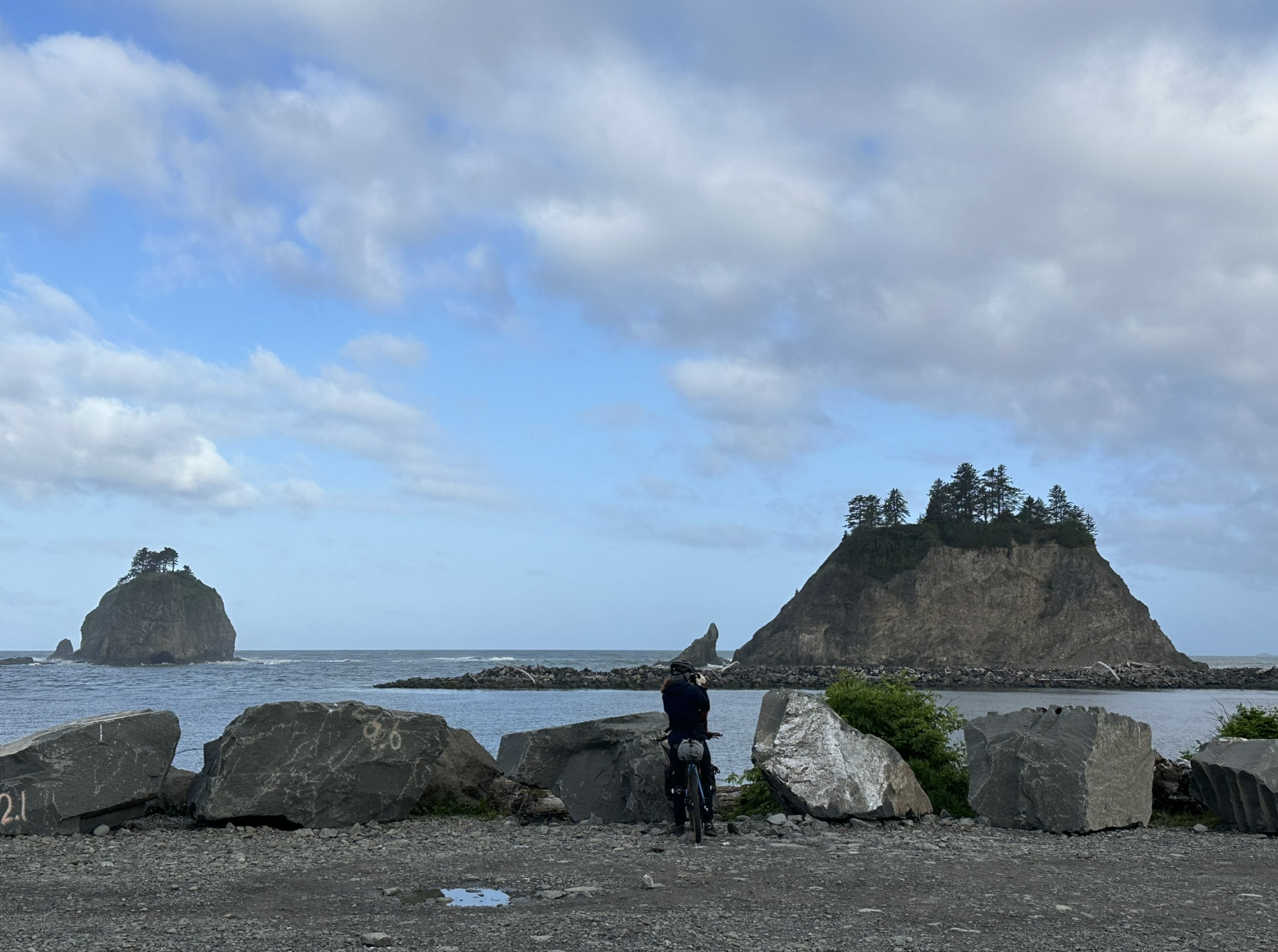
The village of La Push is not a particularly old place. Though Native Americans have lived, died, fished, gathered and built rich meaning and community in these beaches and forests for thousands of years, La Push as a settlement has a more recent and darker origin. It is the product of a genocidal campaign against the peoples of the Olympic Peninsula, and in particular the Quileute and Hoh nations.
For as long as the ageless memory of legend recalls, the Quileutes flourished in the territory which originally stretched from their isle-strewn Pacific beaches along the rain forest rivers to the glaciers of Mt. Olympus.
Quileute historical statement
The Quinault Treaty of 1855 was concluded between Isaac Stephens, Washington Territory’s early military governor and several peninsular peoples including the Quinault. Stephens was quite a piece of work. He once declared martial law in Pierce County (today’s Tacoma), arrested a sitting judge, raised a private militia called the WTV (Washington Territorial Volunteers — shudder) and was in turn almost arrested himself by US marshalls. When he was found in contempt of territorial court for all of this, he simply pardoned himself. He later died rather heroically in the Civil War immediately before Abraham Lincoln could promote him to full general. Just like the seven other local agreements which preceded it, Stephen’s treaty was no treaty at all but rather a theft and genocidal displacement of tens of thousands of innocent people. Gone were access to traditional burial, gathering, hunting and fishing grounds across the peninsula. Severed were ancient community and familial ties, trading relationships and rivalries. Destroyed was a complex, interrelated and ancient set of civilizations spanning contemporary Western Washington. Stephens and his treaty even managed to cause the extinction of a special (and rather cute) species of wooly dog bred only by these peoples.
In recompense for all of these lives, all of these riches, The US and Stephens offered Native Americans small amounts of sliver to move into relatively tiny river-mouth settlements like La Push, to which they were to be confined permanently. Since these lands were often outside of traditional tribal boundaries and could not support a fully traditional way of life, most refused to move. Those thousands that did received $25,000 USD total to split between all of them. Updated to today’s valuations, the value of an entire ancient people was calculated by the United States to be less than the current price of my house in North Seattle.
***
Kelly and I watched the village come to life and prepared to to begin our ride. A woman with long black hair opened a beachfront Tribal office. A bell sounded, and behind us the little Coast Guard station began another day. One guardsman raised the flag while his partner stood and saluted, his back stiff. At Native Grounds Coffee, we chatted with the bubbly proprietor and a pair of friendly ocean ecologists. We filled up our water bottles, and prepared to head right back up the hill we’d descended on the bus from Forks less than an hour before. Behind us rumbled the Pacific Ocean — huge, gray and sleepy in the morning. In imitation of other riders we’d seen on social media, we’d dipped the front tire of our bikes into the waves, feeling thankful for the unusual calm in this place of frequent and violent storms and a bit silly (and lucky) to be engaging in such a superstition.

Starting up the old road, we began our first few feet of real climb. The beautiful, modern Tribal school slid by, as did the trailheads to Second and Third beaches. Finally leaving all of La Push behind, we hit the open road and wound through clear cuts and forested hills as we approached the northern outskirts of Forks. Crossing US 101, we then slid onto a series of successively more rough gravel roads, which took us deep into the Callawah River drainage — a long, flat-bottomed forested valley — and then after about 10 miles up a steep drainage that led over 2000 foot ridge saddle to the north. At the top Kelly and I paused, sweaty in the cool air. There wasn’t much of a view since we were surrounded by higher foothills and mountains, but we treated it like a victory. We’d climbed our first “bump” of steep dirt and had already progressed from ocean to ridge top. It felt thrilling to be doing this again, doing this at all.
The descent was even better, and I may have whooped and hollered quite a bit while zipping, Star-Wars-speeder-bike style, through the massive tree trunks and down the rutted Forest Service track. The sky became gray but still rainless. In a large clear cut, we surprised a great herd of Roosevelt Elk, who rumbled away from our bikes, thankful that selection (natural or unnatural) had caused them to forget that they could have trampled us easily under hoof. We arrived at the northern valley bottom in a band of forest between the ridge we’d descended and highway 101. At this point we linked up with the Olympic Discovery Trail, a remote and rather astonishingly paved bikeway that parallels the highway in this remote area. After about 15 miles, we crossed the highway and entered a fun maze of single track trails which sloped down some 15 more miles toward Lake Crescent, our destination for the night.
According to Clallam Legend (the Clallam being a sister people to the Quileute, kin but also rivals) Lake Crescent and its smaller, shallower neighbor Lake Sutherland were severed from each other when the nearby mountain Tsulh-mut, called Storm King in English, became angry at fighting and slave-raiding between the related peoples. Breaking off a piece of his own peak/crown, Tsulh-mut hurled a massive foothill-sized boulder so as to sever both the lake and the two peoples’ territories. This legend’s basis in geological history has been confirmed by scientists who have shown that a massive landslide did indeed occur here in ancient times. So we know now that Tsulh-mut did split the lake, though whether or not he meant to, or whether this action produced any kind of detente between the Clallam and the Quileute is unknown.

Back on the Discovery Trail, we rounded the lake’s northern shore. Its surface was quite calm, a table top ruffled only by occasional movements of spring air. Hunting for a camping spot with minimal bugs and access to water was not the easiest task, but we eventually decided on a slim pebble beach, low and out of sight of the trail. I pumped and filtered water from the lake while Kelly fired up her stove. We ate and watched the sun descend over the lake. It was Friday, so the work week was ending leaving only the time of peace. The clouds flashed pale pink, blue, white-gray. I lit some candles. In the dark of my tent, I could feel the wind pick up off the severed lake. Through the cold night I felt the the massive, invisible body of Tsulh-mut towering nearby. If you pass this way I encourage you to stop even briefly to see and remember this mountain and its lake. Storm King, Tsulh-mut, great hatless king. He who long ago cast down his own crown for the sake of a now-haunted peace.