Welcome to a series of posts written during and just after a ride across the entire width of our home state of Washington. I undertook this adventure with my friend Kelly in May, 2024. Kelly and I, aside from working together, have always been connected by bikes. We first met on the autumn slopes of Park City Utah, after I’d just finished a somewhat epic ride from the PNW to that state to coincide with a work event. For some reason, I’d decided that long distance road touring qualified me to do some difficult single-track mountain biking, despite a near total lack of experience. A very large boulder and a sharp turn disagreed, and I was rather seriously concussed. It was none other than Kelly who happened to be coming down the trail behind me and was able to scrape my long, awkward form from the trail and make sure that I was okay (I was — as much as I ever am.) She has been teaching me about biking, particularly non-road biking and cool gear, and riding with me on and off ever since.
Without further ado, here’s a list of the posts that make up this story. Below, I’ll include some information about our route and gear.
Gear
Kelly and I are bikepacking on this trip — a stype of bike touring so named because it combines light weight touring, mountain biking and riding in remote and beautiful areas. We use a single bike for all types of terrain, ranging from pavement to gravel to some single-track. Bikepacking has a long history. Indeed, some of the earliest bicycles were built to contend with the rough roads of the time, and bicycles have a long history of military application in mountainous regions, particularly in Europe. But the last of Europe’s bicycle brigades was disbanded in 2003, and in recent decades, too, recreational biking has become ever more specialized, focusing on certain types of terrain: cyclocross, gravel, sand, even snow commuting, not to mention the ever-more (often uselessly) specialized and minimized road bikes.
By contrast, our equipment on this trip is designed to be able to handle anything: road/pavement, dirt roads, rough gravel and some trail and completely off-road riding. Here are our particular setups:
Kelly rides a Soma Wolverine frameset … her drivetrain is a bit of mystery to me, though I know it’s a 1×8 like mine, and that she, like me, would have preferred an additional climbing gear. Her brakes are hydraulic and rather high-end. Her headset features swept-back flat bars that despite their no-drop, provide a variety of hand positions. Her gear lives in two mini-front-panniers, a dry bag from mountain laurel designs mounted on a rear rack and a full custom back from Rockgeist. Especially to people who know more about mechanics and components than I do, her rig is a complete head-turner.
My own bike is an enormous Salsa Fargo gravel/touring frame. It’s basically a massive steel mountain bike with some carbon and no shocks, but set up with a dropped headset for long touring. I have a 1×8 drive train and mechanically regulated disk breaks. For packing I use an excellent stem bag and full frame bag, both from Revelate. Two fork-mounted everything-cages allow me to carry stuff up front, and I have two stem-mounted bags for water and immediate needs. My pad and was lashed to my headset old-school with two small bungees.
Both kelly and I use the GPS-enabled Wahoo Element Bolt computer for navigation, its accompanying app (excellent) and Ride with GPS for route editing and wrangling. The Wahoo Bolt proved to be the perfect computer for this (or any) tour, and once we got the hang of getting route information from Ride With GPS to the Bolt, route planning and navigation were reliable the entire way.
Route
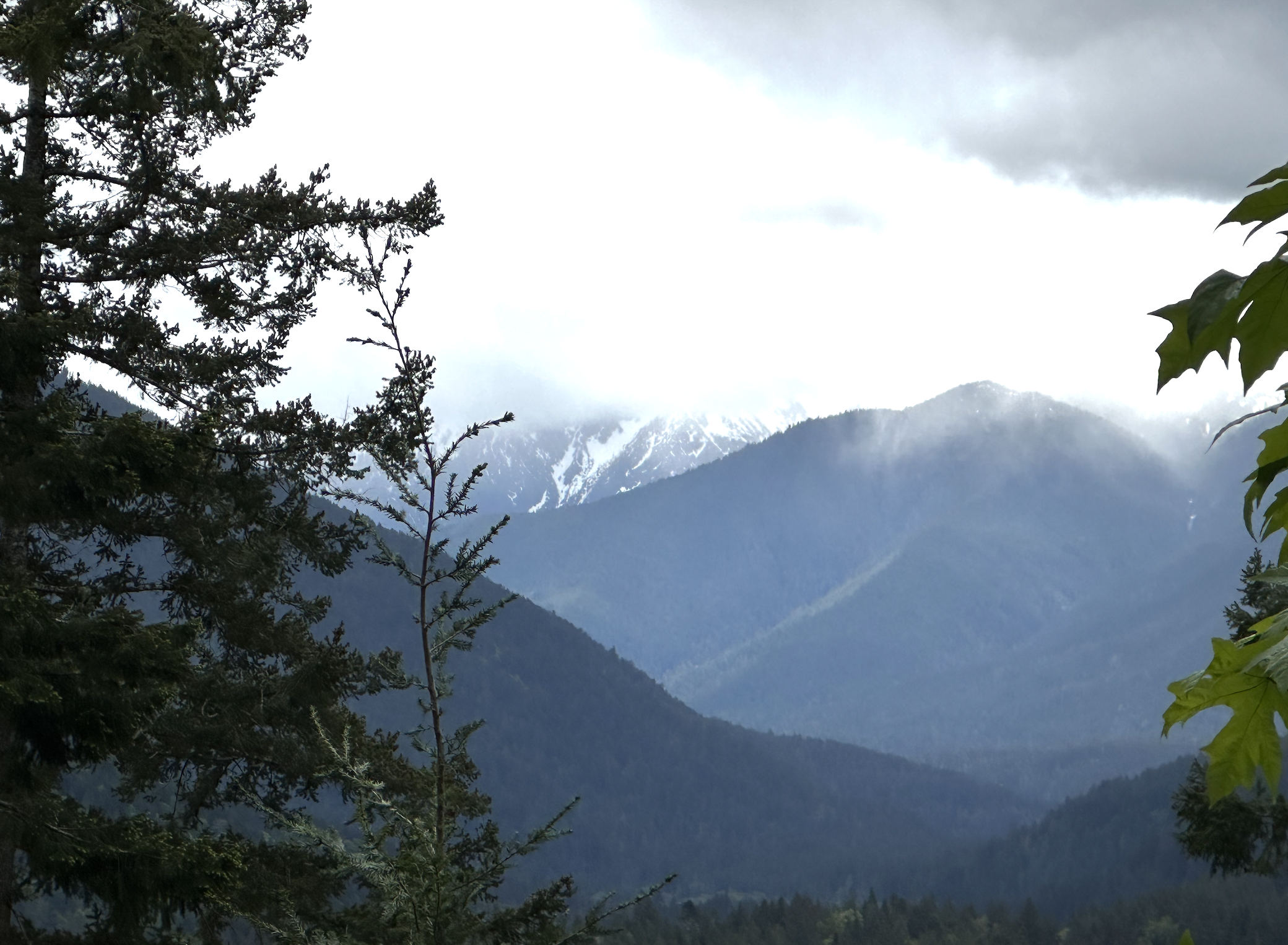
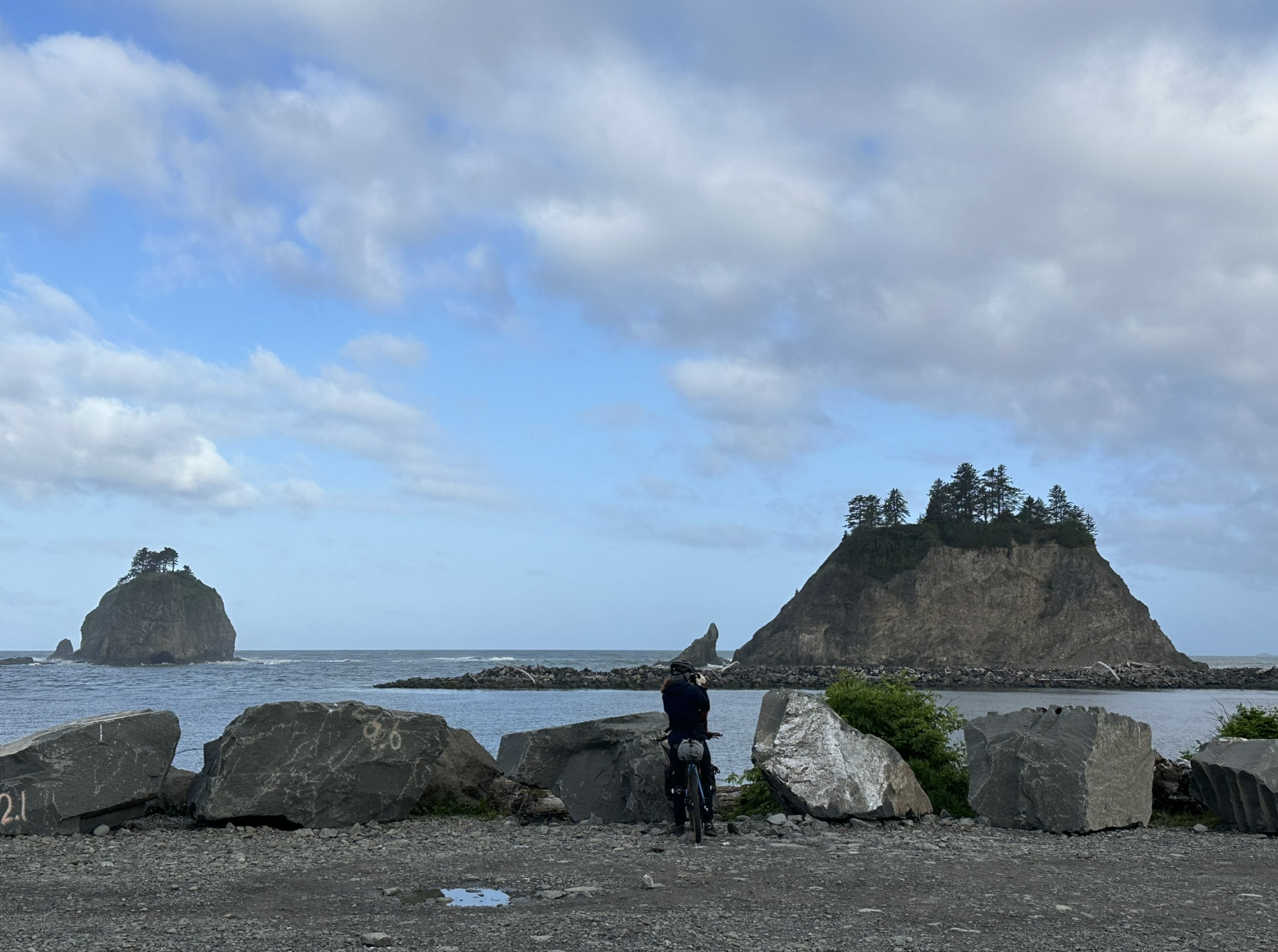
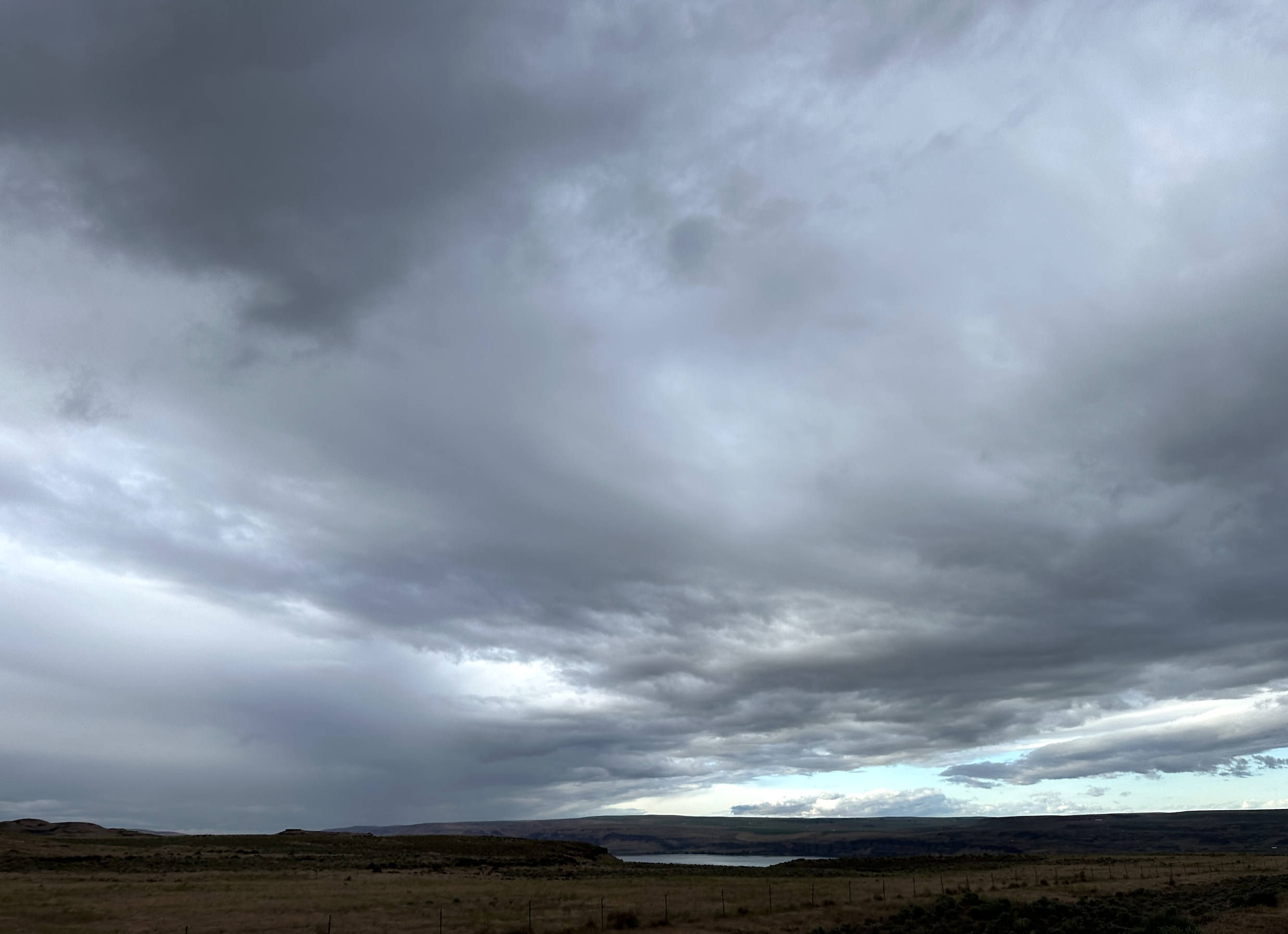
Our purpose on this trip was to follow the XWA route across the entire state of Washington. The route, invented by an energetic bikepacker named Troy, begins on the Pacific coast at La Push, WA, and snakes its way west to east across the state from the rainforests and mountains of the Olympic Penninsula, through the Puget Sound region, across the mountains to the Columbia Basin and then up the arid slope and into Eastern Washington and the vast Palouse.
The route is … challenging. On digital paper, it features something like 40,000 feet of total climbing across 690 miles, and is about 80% off-road. There are significant portions of difficult terrain, particularly between Ellensburg and the Columbia, and also some portions of high elevation. In general, it seems to be designed to maximize time on remote and off-road routes, and encourage use of non-motorized trails and roads. While all of this was … er … interesting to us, and while we were certainly up for a challenge, we ended up following, at least after the first few days, a “light” version of the route that trimmed out some of the most technical and extreme portions of the route and made allowances for continued snow coverage, which was an issue at this time in May. The XWA uses several of Washington’s marvelous public trails, including the Cascades-to-Palouse, a semi-maintained route that follows the route of the former Milwaukee Railroad, now transformed into a (very long and snake-y) state park. This route and trip would not be possible without this amazing public resource.
Time and Preparation
We prepared for this adventure! A bunch of weekends out in the mountains and Islands getting our bodies ready, careful gear and bike preparation, ensuring that we had enough uninterrupted time, figuring out how best to get out to La Push and back home from Eastern Washington — all of this took work.
We decided (for relationship reasons, and the principle of it) to not ask for rides from loved ones, but to get to the beginning and the end of this adventure on public transportation. And so we began by taking a ferry from downtown Seattle, then a bus to Port Angeles. We arrived at the transit center in that wind-swept town just as the car ferry from Canada pulled in. Oddly, there had been some kind of a vehicle fire on the ferry, which meant that we found the little port choked with emergency vehicles from all around the region. We ate a hamburger and watched the chaos of or a bit, but then continued on our second bus ride of the day, which took us through the varied forests, clearcuts and slopes through which our ride would take us over the next day or so. We spent the night in the town of Forks, and then took one final morning bus (much praise, Clallam Transit for your excellent rural service) along with several Native American school kids on their morning commute to the tribal school in La Push. The wild Pacific peeked into view, more tranquil than usual under an even stranger (for this part of the world) blue sky. We were ready to start!